Retraite de yoga et bien-être : s'aligner sur l'équinoxe d'automne
Two pieces of news arrived this week with a quiet common thread: Your Harlow is announcing an Autumn Equinox Yoga and Wellness Retreat, while Dezeen reports on architect Shigeru Ban's new coastal…
Constance Duret, Kinésiologue et formatrice en yoga postural·mis à jour 27 août 2026
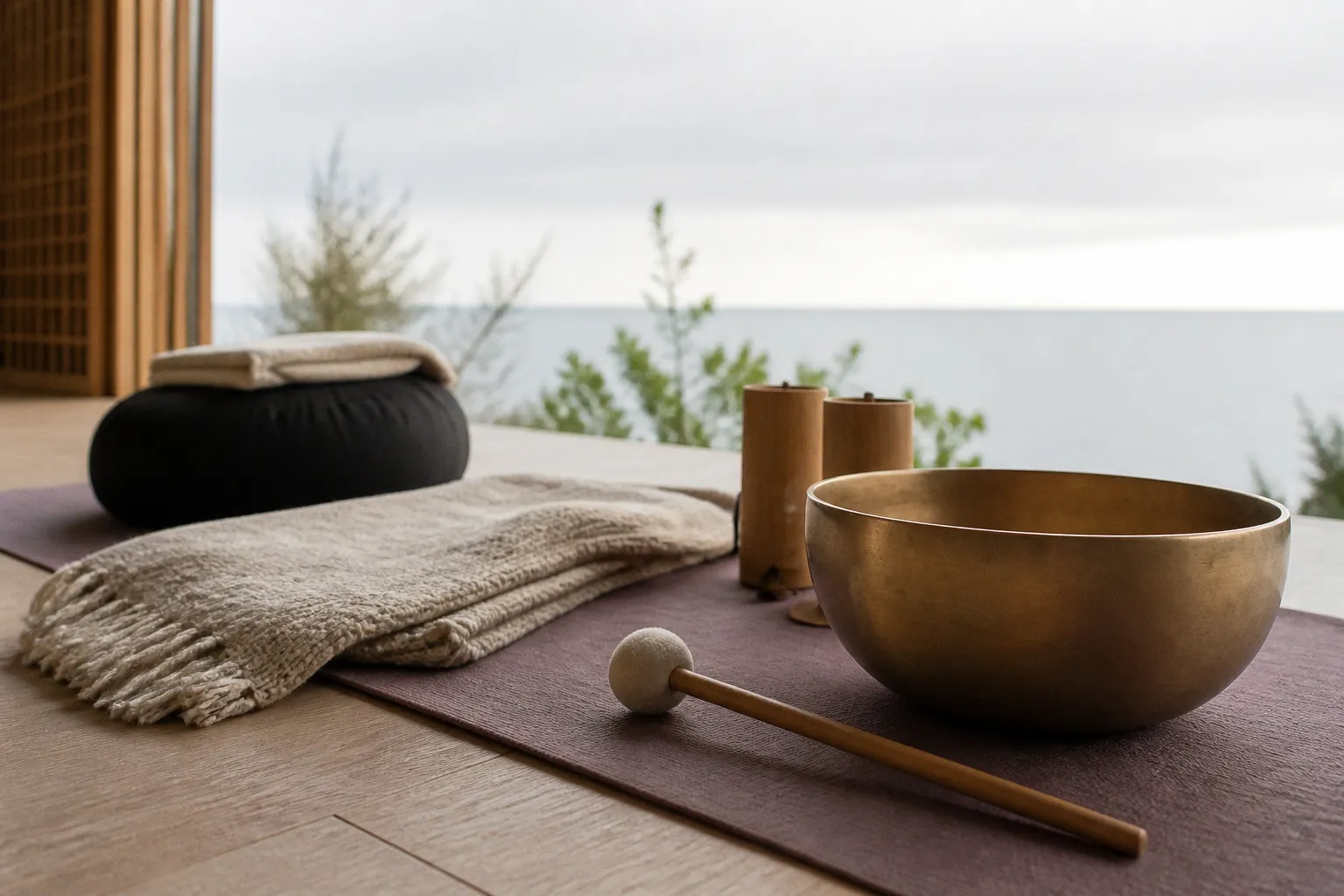
Two pieces of news arrived this week with a quiet common thread: Your Harlow is announcing an Autumn Equinox Yoga and Wellness Retreat, while Dezeen reports on architect Shigeru Ban's new coastal wellness project unveiled on Awaji Island, Japan, focused on meditation, yoga, and sound therapy. What caught my attention was not the travel but the convergence: an equinox-themed retreat, and a sound-based practice, both arriving at the moment our nervous systems begin shifting gears. There's a tension pattern I see every September in my studio — students arrive with breath held high, shoulders climbing toward the ears, jaw set against a season they haven't consciously registered yet.
L'équinoxe, un événement postural avant d'être symbolique
A retreat centered on the equinox makes sense to me for exactly this reason. It offers a few days where the environment removes the friction that usually pulls you out of alignment before you've finished exhaling. What I want to flag, though, is what a retreat cannot do: it cannot replace the daily micro-adjustments that keep your nervous system flexible. The integration happens on your mat the week you return, not on the drive home from the airport.
If you feel the September shift already, here's a quick scan before your next practice. Stand in tadasana and observe where the breath wants to land — chest or belly? Where do the shoulders sit relative to the ears? What is the jaw doing? You're not fixing anything yet; you're registering. That observation is the first adjustment.
La sonothérapie comme porte d'entrée vers le silence
Shigeru Ban's Awaji Island project — meditation, yoga, sound therapy — confirms something I observe regularly. Students who struggle with silence often find their way back to it through vibration. Sound offers a bridge for the parasympathetic system that pure stillness does not. When the nervous system is locked in sympathetic activation, silence can amplify the noise rather than soften it; vibration gives the vagus nerve a frequency to follow.
To test this without booking a flight to Japan, try this in your next savasana: one hand on your lower belly, one on your sternum, hum for two minutes at a pitch that feels low in your chest. Don't aim for a "correct" sound. Notice what shifts in your rib cage, when your jaw releases, whether your exhale lengthens on its own. You're not performing a therapy — you're offering your body an entry point to rest it already knows.
Avant de réserver, nommez ce que vous cherchez
The announcements are tempting, and a well-designed retreat can indeed recalibrate a season. Before you click "register," I'd invite you to do something slightly clinical: name the specific tension you hope the retreat will resolve. Is it a shoulder pattern? A breathing habit? A chronic difficulty with stillness? The clearer the question, the easier it becomes to choose — silence over sound, movement over rest, solitude over community, or the reverse.
We don't need to wait for an equinox, or for a coastal retreat on Awaji Island, to begin that work. But the season is a fair occasion.